%20-%20Copie.png)
A Curated Guide to Latin Books: From Ancient Texts to Modern Literature
Updated: Feb 27
The journey into Latin literature is a pursuit of profound beauty. Yet, the path is often obscured. The sheer volume of available latin books can feel more like a labyrinth than an invitation, leaving the aspiring reader uncertain of the first, or next, step. The art of selection becomes paramount, a decisive act that separates stagnation from true intellectual momentum.
This is not merely about finding a text; it is about discovering the right one for your unique place on the path to fluency. This guide offers a curated collection, meticulously designed to illuminate that journey. We navigate from the foundational grammar of a first textbook to the eloquence of authentic classical prose and the unexpected delight of modern compositions, ensuring your motivation is sustained by engaging and appropriate material.
Here, you will find the precise volume for each stage of your development. Consider this your definitive map, crafted to transform the challenge of choice into the confidence of a well-guided scholar. Your personal library of Latin begins here.
Key Takeaways
Understand the two core pedagogical approaches to select a foundational textbook that aligns with your learning philosophy.
Discover how to bridge the gap between structured exercises and authentic literature using curated graded readers and bilingual editions.
Develop a strategic approach for engaging with unadapted classical texts, the pinnacle of Latin literary study.
Explore the vibrant landscape of contemporary latin books and engage with the language as a living, evolving art form.
Table of Contents The Foundation: Selecting Your First Latin Textbook Building Fluency: The Crucial Role of Graded Readers and Novellas The Bridge to Mastery: The Power of Bilingual Editions Engaging with the Classics: Approaching Original Latin Texts The Renaissance of a Language: Modern Latin Books
The Foundation: Selecting Your First Latin Textbook
A child's journey into Latin begins not with isolated words, but with a foundational text. This choice is paramount, as the textbook becomes the architectural blueprint for their understanding. It dictates the pace, the perspective, and the ultimate mastery of the language. The market for latin books is defined by two core philosophies, each offering a distinct path toward fluency.
Understanding these methodologies is the first step in curating the ideal learning experience for your child. The decision should align with their innate learning style, ensuring the process is as elegant as it is effective.
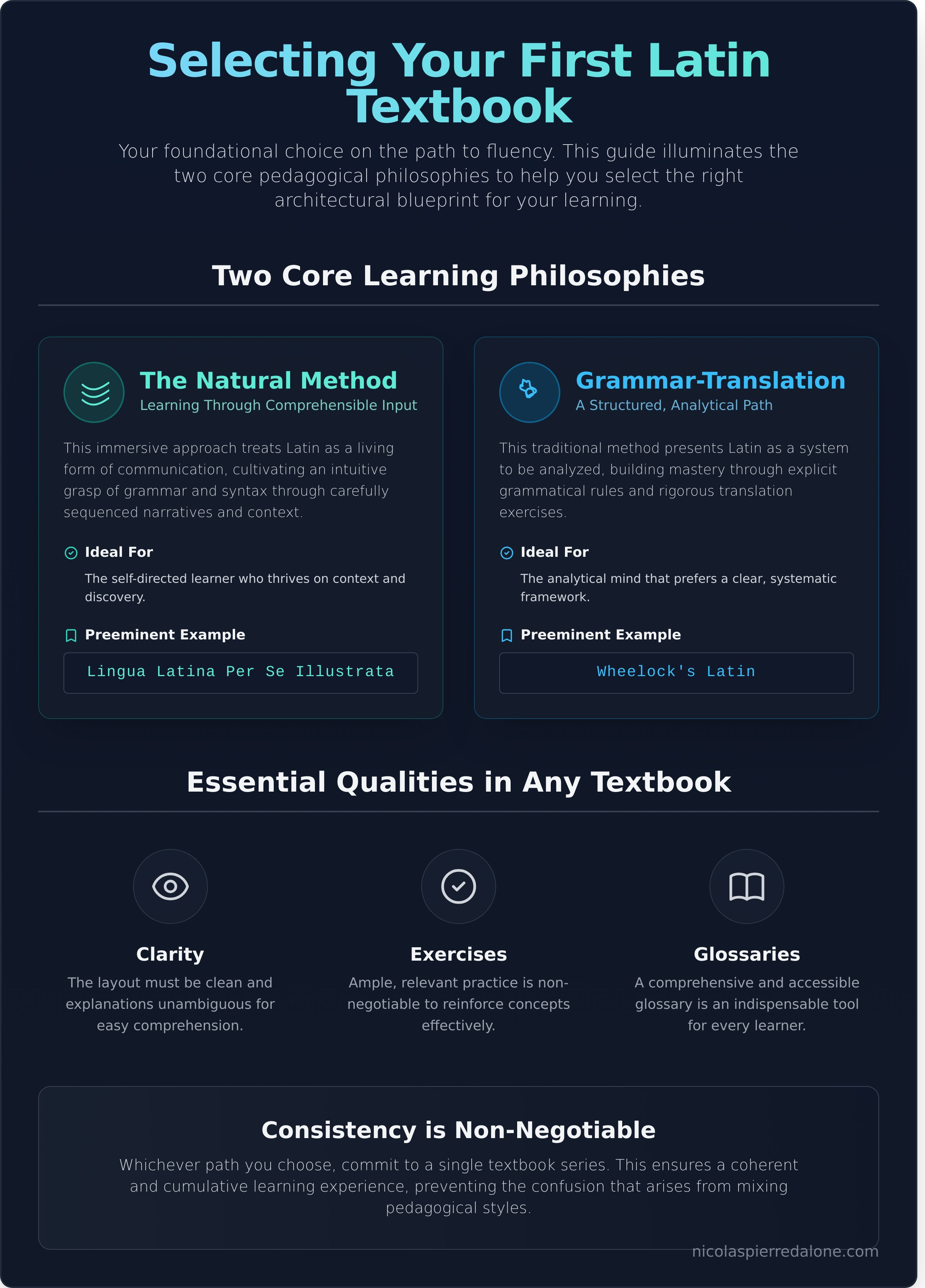
The Natural Method: Learning Through Comprehensible Input
This approach immerses the student in the language itself, treating Latin not as a historical artifact but as a living form of communication. The preeminent example is Hans H. Ørberg's Lingua Latina Per Se Illustrata. Through carefully sequenced narratives and marginal notes written entirely in Latin, it cultivates an intuitive grasp of grammar and syntax. This method is ideal for the self-directed learner who thrives on context and discovery.
The Grammar-Translation Approach: A Structured Path
In contrast, this traditional method presents Latin as a system to be analyzed through explicit grammatical rules and rigorous translation. Classic textbooks like Wheelock's Latin epitomize this structured path, appealing to the analytical mind that prefers a clear, systematic framework. This approach is exceptionally effective in preparing students for advanced academic study and a deeper engagement with the comprehensive history of Latin literature.
Whichever path is chosen, consistency is non-negotiable. Committing to a single textbook series ensures a coherent and cumulative learning experience, preventing the confusion that arises from mixing pedagogical styles. The best latin books are not merely collections of rules, but curated pathways to understanding. When making your selection, look for these essential qualities:
Clarity: The layout should be clean and the explanations unambiguous.
Exercises: Ample practice is required to reinforce concepts.
Glossaries: A comprehensive and accessible glossary is an indispensable tool.
Building Fluency: The Crucial Role of Graded Readers and Novellas
Textbook grammar drills build a foundation. True fluency, however, is forged through extensive reading. This is the domain of the graded reader and the modern novella-essential tools that bridge the chasm between structured exercises and authentic classical literature. These carefully constructed texts use controlled vocabulary and grammar, allowing young learners to read entire stories without constant recourse to a dictionary. The result is an organic acquisition of language, building reading speed, reinforcing syntax, and instilling a profound sense of confidence.
What to Look for in a Latin Reader
Selecting the right reader is a curatorial act. It requires precision. An effective reader is not just a collection of words but a carefully designed experience. Key elements to consider include:
Level Alignment: The text must correspond to the student's progress in their primary textbook, introducing new concepts incrementally.
Integrated Support: An accessible glossary or on-page vocabulary notes are non-negotiable. They facilitate a smooth reading flow.
Narrative Integrity: A compelling plot is paramount. The story must sustain interest and motivate the reader to continue.
Series like the Cornelia et... books exemplify this philosophy. They are crafted specifically for young learners, offering an ideal entry point into the world of narrative Latin.
From Adapted Classics to Original Stories
The landscape of Latin readers offers a rich duality. Many excellent latin books adapt classical myths or historical events, simplifying the prose of authors like Livy or Ovid. These texts provide a valuable, accessible introduction to the cultural heritage of Rome and can inspire a deep dive into Latin literary history.
Alongside these are original stories written in simple, modern Latin. These novellas present relatable characters and contemporary narrative structures, preventing the learning fatigue that can arise from a singular focus on antiquity. This variety is crucial. It ensures the learning journey remains dynamic and engaging, treating the language not as a relic, but as a living medium for storytelling. Discover Latin stories crafted for modern learners.
The Bridge to Mastery: The Power of Bilingual Editions
The journey into a classical language requires more than memorization; it demands immersion. Bilingual, or parallel-text, editions offer the most elegant and efficient path to this state. These specialized latin books present the original text on one page and a faithful English translation on the facing page. This structure is a deliberate design choice, engineered for seamless learning.
The methodology is simple yet profound. It removes the primary friction point for new learners: the constant, disruptive need to consult a dictionary. By providing immediate, contextual clarification, the parallel-text format allows the student's focus to remain on the narrative flow and the intricate beauty of Latin syntax. This direct engagement accelerates vocabulary acquisition and builds an intuitive understanding of sentence structure, transforming a laborious task into an intellectual pleasure.
How to Use Parallel Texts Effectively
To extract the maximum value from this format, a disciplined approach is essential. The goal is not to rely on the translation but to use it as a precise tool for verification and deeper comprehension.
First Reading: Approach a paragraph in Latin first. Attempt to decipher its meaning using your existing knowledge.
Verification: Use the English text to confirm your understanding and clarify any ambiguities. Note new vocabulary and complex phrases.
Structural Analysis: Compare the two versions, focusing not on word-for-word equivalents but on how Latin grammar creates meaning.
Final Immersion: Re-read the Latin passage. With the meaning now secure, you can appreciate the author's rhythm and style.
Beyond Direct Translation: Appreciating the Nuances
The true power of parallel texts emerges as the student advances. This format becomes a masterclass in the art of translation, revealing how meaning is preserved-or subtly altered-across languages. It highlights idioms and cultural expressions unique to the Roman world, offering insights that a simple dictionary cannot. For both dedicated self-learners and students engaging with authoritative editions of classical texts in academic settings, this method provides the most direct connection to the author's original voice. It cultivates a deep, nuanced appreciation for the literature itself, moving beyond mere translation to true understanding.
Engaging with the Classics: Approaching Original Latin Texts
After building a solid foundation with series like Cornelia et..., the dedicated student eventually arrives at the ultimate goal: reading unadapted classical authors. This transition is a significant intellectual challenge, moving from curated language to the authentic, complex prose and poetry of ancient Rome. It is a demanding step, yet it offers the profound reward of engaging directly with the literary masters of the ancient world.
Success at this stage requires patience, discipline, and the right tools. The objective is not merely to translate, but to comprehend the nuance, style, and cultural context embedded in the original text. This is the culmination of study, where language becomes a direct conduit to history and art.
Starting with Latin Prose
The traditional entry point into authentic prose is Julius Caesar’s De Bello Gallico. Its direct, third-person narrative and relatively unadorned syntax provide a clear and logical bridge from preparatory texts. For a more intricate challenge, the orations of Cicero offer a masterclass in rhetorical structure and persuasive power. For either author, it is essential to use student editions that provide line-by-line commentary and vocabulary support, transforming a difficult text into an accessible lesson.
An Introduction to Latin Poetry
Latin poetry introduces new layers of complexity, including strict metrical patterns, evocative imagery, and a vocabulary rich with artistic license. The short, personal poems of Catullus serve as an excellent introduction, offering intense emotion in a compact form. The ultimate epic, Virgil's Aeneid, represents a pinnacle of the craft. Approaching these works requires scholarly editions that meticulously explain scansion and poetic devices, unlocking the musicality and artistry of the verse.
To navigate this advanced stage, we recommend focusing your library on specific, foundational authors. These collections of original latin books form the bedrock of a classical education:
For Prose: Start with Caesar for clarity and structure, then progress to Cicero for rhetorical depth.
For Poetry: Begin with the personal and direct poems of Catullus before aspiring to the national epic of Virgil.
This deliberate progression transforms the formidable task of reading the classics into a structured and deeply satisfying intellectual pursuit.
The Renaissance of a Language: Modern Latin Books
The notion of Latin as a 'dead' language is a profound misconception. Far from being a relic confined to ancient manuscripts, Latin is experiencing a vibrant renaissance, giving rise to a new generation of modern latin books. This revival offers a curated world of literature for the modern student, transforming the learning process from a historical exercise into a living, dynamic engagement. It presents an exciting frontier where classical elegance meets modern narrative.
This movement is defined by two distinct yet complementary currents: the masterful translation of modern classics and the bold creation of entirely new works. Each provides a unique pathway to understanding, making the language more accessible, relatable, and profoundly entertaining.
Familiar Stories in a Classical Tongue
Translations of beloved modern stories, such as Harrius Potter et Philosophi Lapis (Harry Potter and the Philosopher's Stone) or Hobbitus Ille (The Hobbit), serve as an elegant bridge for young learners. The familiar plot provides an intuitive context, allowing students to absorb new vocabulary and complex syntax with greater ease. These works are not mere academic exercises; they are a testament to the timeless flexibility and expressive power of the Latin language.
Original Creations: Science Fiction and Beyond
Beyond translation lies the innovative world of original fiction. Genres like science fiction push the boundaries of the language, demanding new yet classically-derived vocabulary for concepts unimagined by the Romans. This fusion of ancient language and futuristic storytelling creates a uniquely compelling learning experience, proving that Latin can articulate the complexities of any world, real or imagined. Explore a universe of science fiction, reborn in Latin.
This evolving library of contemporary latin books is more than an educational resource; it is proof of a language's enduring artistry. By engaging with these texts, young readers do not simply learn Latin-they become part of its continuing legacy, connecting a rich heritage with the boundless possibilities of the future.
An Invitation to the Living Tradition
The path to Latin mastery is a curated ascent. It begins with foundational grammar and blossoms through the narrative immersion of graded readers, ensuring the final step to original texts is a confident arrival, not a struggle. The essential bridge in this journey is the bilingual edition, allowing for a direct, intimate dialogue with the author's original voice.
This deliberate progression through the world of latin books transforms the student into a scholar, one capable of engaging with two millennia of literary heritage. For the modern classicist, this tradition is not merely preserved; it is advanced. Curated by author and classicist Nicolas Pierre d'Alone, the Bibliotheca Latina Antica offers more than just texts; it presents works of art.
Discover expertly crafted bilingual editions and pioneering original works, including science fiction in Latin, that honour the past while boldly shaping the future of the language. Your dialogue with the classics begins now. Explore the Bibliotheca Latina Antica collection.
Frequently Asked Questions
Where is the best place to buy Latin books?
Acquiring the right tools is the first step in any craft. For foundational Latin books like the Cornelia et... series, we recommend purchasing directly from the publisher. This guarantees the most current, authentic editions. Alternatively, specialist academic booksellers, both online and in-person, offer a curated selection of classical texts. These sources value the heritage of the language and provide an experience that transcends a simple transaction, ensuring a worthy start to your studies.
Are there audiobooks available to improve my Latin pronunciation?
Mastering pronunciation is an essential auditory craft. Many modern Latin curricula, including select reader series, are accompanied by audio recordings. These are often available directly from the publisher or through dedicated platforms. Such resources are not mere supplements; they are indispensable tools for attuning the ear to the classical cadence and rhythm of the language. They provide a direct connection to the spoken heritage of Latin, transforming silent text into living sound.
How many Latin books should I read to become fluent?
Fluency is not a destination reached by counting volumes. It is a state of deep immersion, an intimate understanding of the language's soul. The journey with Latin books begins with foundational readers and progresses to authentic texts. The key is not quantity, but consistent, mindful engagement. True command of Latin is a testament to dedication and a patient dialogue with its literature, a process that unfolds over time rather than a set number of books.
What is the difference between Classical Latin and Ecclesiastical Latin books?
Consider them two distinct dialects born from a shared heritage. Classical Latin reflects the pronunciation and literature of the Roman Republic and early Empire-the language of Cicero and Virgil. Ecclesiastical Latin is the living tradition of the Roman Catholic Church, with a pronunciation shaped by Italian phonetics. While the core grammar is identical, the auditory experience and textual focus differ significantly, each offering a unique aesthetic and historical resonance. Your choice defines the path of your study.
Can I learn Latin just by reading books, without a formal course?
While the path of the self-taught scholar has a certain romance, structure is the foundation of true mastery. Learning Latin solely from books is a formidable challenge, as it lacks the essential feedback and guided progression a formal course provides. A structured curriculum acts as a master artisan, revealing the language's intricate mechanics in a logical, coherent sequence. Reading is vital for immersion, but it is most effective when built upon a disciplined grammatical foundation.
Are bilingual books considered a 'crutch' or an effective learning tool?
A bilingual text is a tool, and its value is determined by the artisan who wields it. Used with discipline, it can be a bridge, offering immediate clarity and reinforcing vocabulary. However, over-reliance can inhibit the development of true reading comprehension. The goal is to engage directly with the Latin text. View the translation not as a substitute, but as a carefully consulted reference to confirm your own interpretation, ensuring your understanding is both accurate and self-derived.


Comments